Hi Folks, It's time for us to revisit our yearly piece on XERA: As many of you already know, Fantistics uses Sabermetric theories to create our player projections model. These theories are the foundation to our successful forecasting history. One of my favorite forecasting models that we monitor here at Fantistics is Expected ERA.
Expected ERA (XERA) depicts a pitcher’s "True ERA" as it bases its expectation on factors within a pitcher's control. These factors include Hits, Walks, Home Runs allowed and K’s. When you consider the inequity with the ERA calculation, specifically related to errors and base runners inherited/left, many including myself consider XERA to be a more precise gauge of ability.
Expected ERA is a term coined by 2 stat researchers (Gill and Reeve), which developed the following mathematical formula ((.575 * H/9 ) + (.94 * HR/9 ) + (.28 * BB/9 ) - (.01 * K/9 ) - Normalizing Factor). The normalizing factor is based on the league (typically in the .270 and .285 range) For more on XERA, visit Dwight Gill's website.
The best way to use XERA is to compare it to the actual ERA. Using the delta between the two indicators we can make observations as to whether the pitcher’s ERA was a true gauge of his ability for the given period.
Overall, based on the MLB pitcher population, XERA and ERA are very close to the same. On average, for the top 150 pitchers, both hover around 4.00
Pitchers with a lower ERA than Expected
XERA is a statistic that I have backtested using data since 1992, and the results are overwhelming. Pitchers who had a lower ERA than expected in an observed year by more than 50 points and also had an ERA that year which was 50 points less than their 3 year average, posted a 50 point or more rise in ERA the following season. This held true in 77% of the individual cases.
Here are the pitchers who had a lower than deserved ERA in 2009:
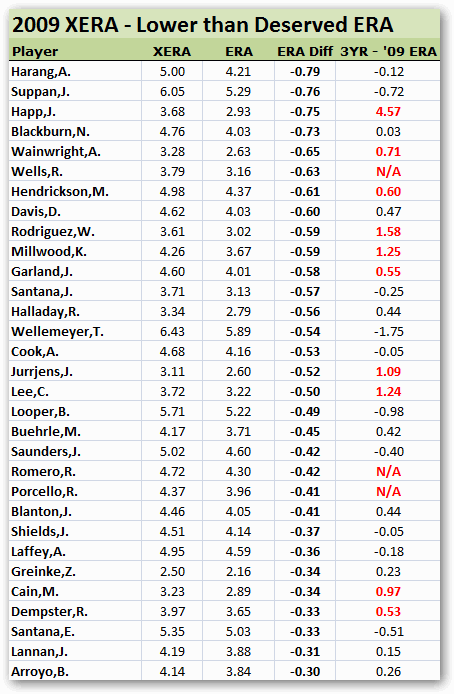
Players that standout and fall into the risk to repeat Zone (these are the players whose 3 Year average ERA improved by more than 50 basis points): Adam Wainwright, Wandy Rodriguez, Kevin Millwood, John Garland, Juir Jurrjens, Cliff Lee, Matt Cain, and Ryan Dempster. Some of these guys are aces, but again history says that 3 out of 4 will see a significant rise in ERA.
In conclusion, the importance of this indicator can not be under estimated and typically over the stretch of a season there is reversion to the mean for a great majority of the players that are outliers. Fantistics Subscribers can find the XERA indicator built into our 2010 pitcher projection ERAs, and can also view the outliers during the season within our Player Charts database.
In a few days we'll highlight the guys who had an ERA which was higher than expected in 2009 (and probably will be undervalued in most 2010 draft rooms).
Have a great day!
Statistician and Publisher -Fantistics Insiderbaseball.com