What type of auction will you be
in this year? If you have a history with the same GMs, what has your
auction been like in the past? If you have last year's auction draft
info, then it's a good idea to look back and see how your league typically bids.
The good news is that none of the three EAV options will be
dramatically different (only a 10-15% difference for a mid tier player.)
Using this tool, you should be able to conceptually find bargains based on the computed fantasy $ valuation, the
Expected Auction Value and the current bidding level.
To illustrate our concept, below is screenshot from the projections software showing the Linear Player Valuation and the
Expected Auction Value calculation side by side:
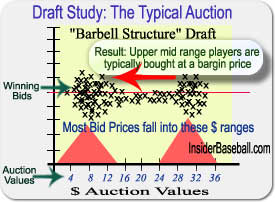
Depending on your
league setup, some players offer additional value based on the
uneven distribution of auction $ spent
during a typical draft.
Middle tier
players are often discounted in an un-linear distribution (unevenly) during a live auction, EAV
attempts to estimate what this value will be for each player. Using EAV with the
Linear Player Valuation ( $ ), you can spot the players that offer
value in the later phase of your draft and what you can expect to
pay for them.
*Please note, these examples are from 2006
In the example above we are using a $260 auction budget. A player like
Eric Chavez is valued at $27.06 based on his year end contribution
(projection) to your fantasy team, while a player like Adrian Beltre
is valued at 22.87 (approximately a $4 difference). Yet, due to his
placement among other players, Beltre will likely fall further
into a discount area (as there is a premium paid for upper tier
players, leaving less money for lesser tier players). Thus, while a
player like Chavez is discounted at 24% based on his proximity to the
upper tier players, Beltre or a player in his class is discounted at
50+%. The net gain in capturing Beltre at ~$11 would be ~$5
(-27.06+22.87+20.43-11.21). And who could not use an extra $5 on draft
day?
More thoughts and suggestions:
Mid tier players typically sell for more than
expected when nominated early during a draft. Resist the urge. As an example: Someone nominates a
player like Joey Mauer very early in the draft. You look at his
projected year end $ value on our software (lets say $14), his
Expected Auction Value shows $8, he's currently auctioning at $13.
Obviously he's trading for a premium, which will mean that other
players in his neighborhood (offensively) could be had at a possible
discount at some point in the draft. Unless you have a strong
conviction, it's probably wise to let him go.
Top tier players typically sell for a discount
during the middle to late stages of a draft, which is sometimes a great situation
for those who have excess funds. As an example: Robinson Cano is not
nominated until the back end of your draft. You look at his
projected year end $ value on our software (lets say $29), his
Expected Auction Value shows $26, bidding is ending at $20.
Obviously he's trading for a discount, if you're in need of a quality
2B and have the excess funds; you have yourself a draft day steal.
Bottom tier players sell at a great discount
when top and mid range players are sold above their expected
levels.
This aggressiveness early in the draft will drive down prices in the
back end, making for great deals. However it's highly improbable to win a
fantasy championship with a team full of bottom tier players, no
matter what the level of value.
In summation, I recommend that you still highly consider the Linear
Dollar Valuation ($) when analyzing players during your auction draft,
as this is the players true value in relation to other players. EAV
is a great tool when used in conjunction with the $ values, but can be
misleading when standing on its own as the relationship between its
value and that of the players worth are not linear.
One of my draft day strategies prior to draft day is to
conduct a mock draft, selecting the type of players that will fill my
roster with "the best fit" (Maximize output with the best allocation
of dollars...the goal of every Fantasy GM and MLB GM). Of importance is not
necessarily the players, but the type of players that should be
selected to produce the best outcome for my team. If you do mock draft
using the software, our Draft Summary section will account for
both the dollars spent and the accumulation of stats. Using these
stats we'll be able to tell you the total Fantasy Point expectation
for your team if you play in a Fantasy Points League as well as the
Rotisserie ranking expectation of your
team for each of the scoring categories.
Here's to your success on draft day!